

In summary:
- PCWorld highlights deceptive Amazon listings advertising HP laptops with “1.1TB” storage, where only 128GB is actual physical storage and 1TB is temporary OneDrive cloud storage.
- These misleading claims matter because the cloud storage expires after one year and costs $100 annually to maintain, leaving buyers with minimal actual storage.
- Third-party sellers exploit lack of oversight to combine physical and cloud storage numbers, creating confusion similar to past tech scams like SoftRAM.
Way back in the 90s, a program called SoftRAM claimed to double your memory without any additional hardware. It, uh, didn’t. (It basically just fooled the memory display and did nothing to improve performance.) I’m reminded of this flimflammery as HP laptops with “1.1TB” of storage pop up on Amazon and Newegg. The catch? 1TB of that is a OneDrive cloud storage trial, which ends after a year.
A Reddit poster documented several listings that showed “1.1 terabytes” of storage on budget HP Windows laptops. That’s 128GB of internal storage—a paltry amount even for a years-old $300 laptop—plus a one-year promotional subscription to Copilot/Microsoft 365 with 1TB of cloud storage. This is, obviously, not physical storage… and it’s a promotion that comes with lots of different Windows laptops.
After the promo ends, you’ll have to pay $100/year to keep it up. So, yes, I’d say any retail listing that refers to this as “1.1TB” of storage and implies it’s actually part of the physical product definitely feels like a scam.
I should point out that the listings included in the original Reddit post are not from HP itself. As VideoCardz notes, they’re all third-party sellers using Amazon’s market system. This is how all the big sites operate now, including Best Buy, Walmart, and Newegg, and a huge volume of products combined with a lack of oversight is letting more and more scummy practices flourish.
I’ve spotted similar listings on Walmart, but I do need to point out that a “1.1TB” listing on Newegg appears to be removed at the time of writing, so maybe somebody over there is paying attention.
Sketchy sellers aren’t anything new. But I get the feeling that this sort of practice might see an uptick as the RAM crisis extends and affordable laptops get increasingly hard to find. 128GB of storage is so low that just operating and updating Windows 11 will become a challenge before long, and I wouldn’t recommend anyone buy a Windows laptop with less than 16GB of RAM at this point.
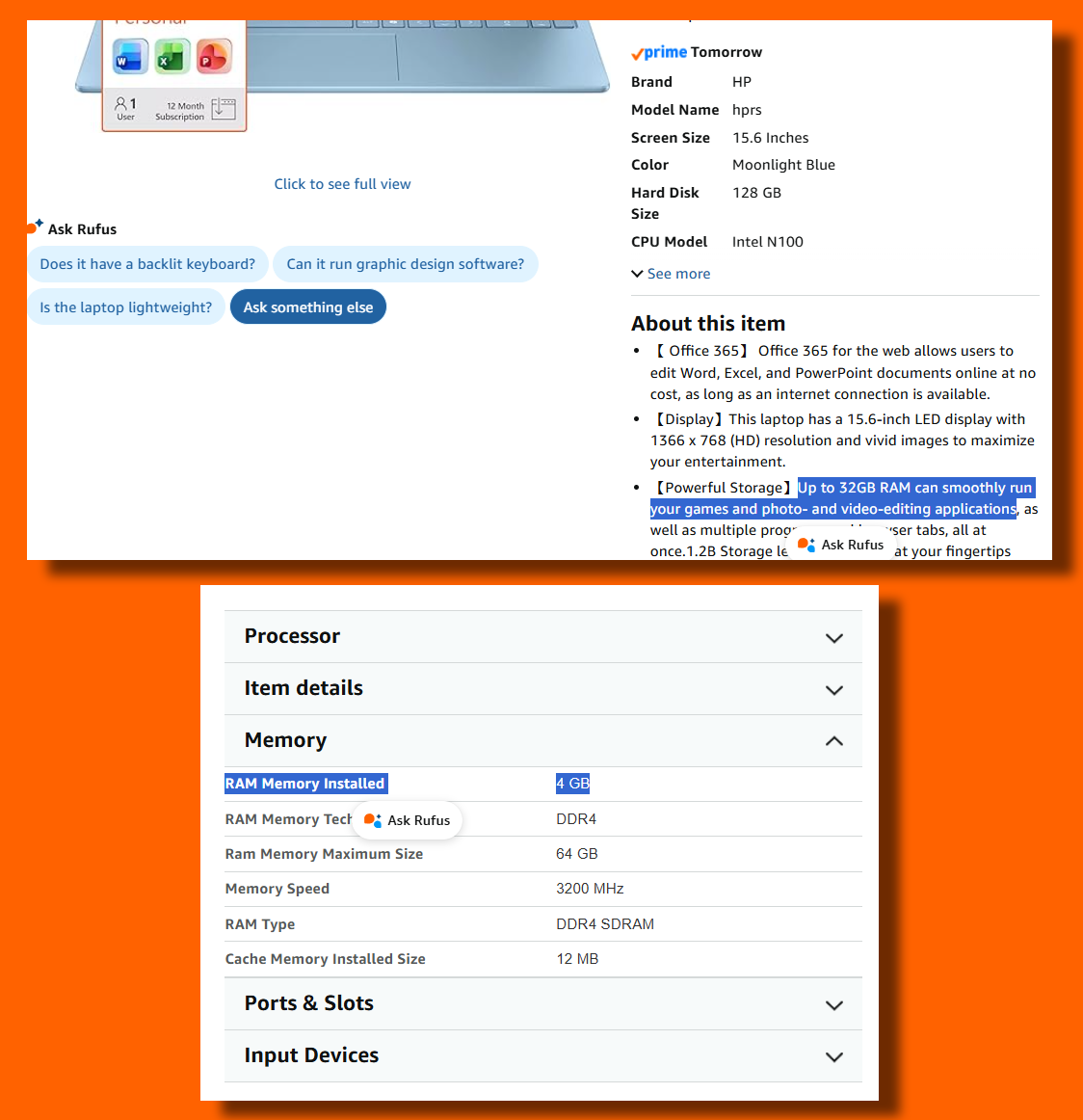
In one of these listings, the seller says the laptop has “up to 32GB of RAM” at the top of the page, despite the specs at the bottom claiming it has only 4GB installed. Gross.
Amazon
Be careful out there, especially if you’re looking for something affordable. I’ve reached out to Amazon’s press contact for a statement and will update this story if I get a reply.
Update, Tuesday, March 10th: — An Amazon spokesperson gave the following response:
“Third party sellers are independent businesses and are required to follow all applicable laws, regulations, and Amazon policies when listing items for sale in our store. If we discover a product that violates our policies, we remove the product immediately. Those who violate our policies are subject to action including potential removal of their account.”
Notably the statement does not clarify whether or not the “1.1TB” descriptor actually violates any Amazon policies.
The links featured in the original Reddit post are now returning blank Amazon pages. However, it’s still easy to find HP laptops claiming “1.1TB Storage” in their Amazon listings under the same setup, at least at the moment.
Author: Michael Crider, Staff Writer, PCWorld

Michael is a 15-year veteran of technology journalism, covering everything from Apple to ZTE. On PCWorld he's the resident keyboard nut, always using a new one for a review and building a new mechanical board or expanding his desktop "battlestation" in his off hours. Michael's previous bylines include Android Police, Digital Trends, Wired, Lifehacker, and How-To Geek, and he's covered events like CES and Mobile World Congress live. Michael lives in Pennsylvania where he's always looking forward to his next kayaking trip.