

At a glance
Expert's Rating
Pros
- Fast 20Gbps performance (with better cable)
- Great heft and silicon jacket
- Good looking
Cons
- Performance issues with bundled cable
Our Verdict
With a Thunderbolt cable the EX20 proved an good performer. With the bundled cable, not so much, though this may be a firmware issue. A great external drive, but wait for the issue to resolve — or use a different cable. Given the current price of SSDs, that’s doubly important.
Price When Reviewed
This value will show the geolocated pricing text for product undefined
Best Pricing Today
Best Prices Today: Glyph Atom EX20 20Gbps SSD

This boutique USB SSD from Glyph is one of the more impressive to roll through our lab recently. In terms of design and performance, that’s a good thing — but the price was also impressively high. However, as time wore on during the review process and NAND prices continued to rise, the EX20’s price began to look more appealing..
Read on to learn more, then see our roundup of the best external drives for comparison.
What are the Glyph Atom EX20’s features?
The Atom EX20 is an exceptionally good-looking, USB 3.2×2 (20Gbps) external SSD from Glyph. It’s all black and clad in a silicone jacket that’s ribbed in a tread pattern to provide a very sure grip.
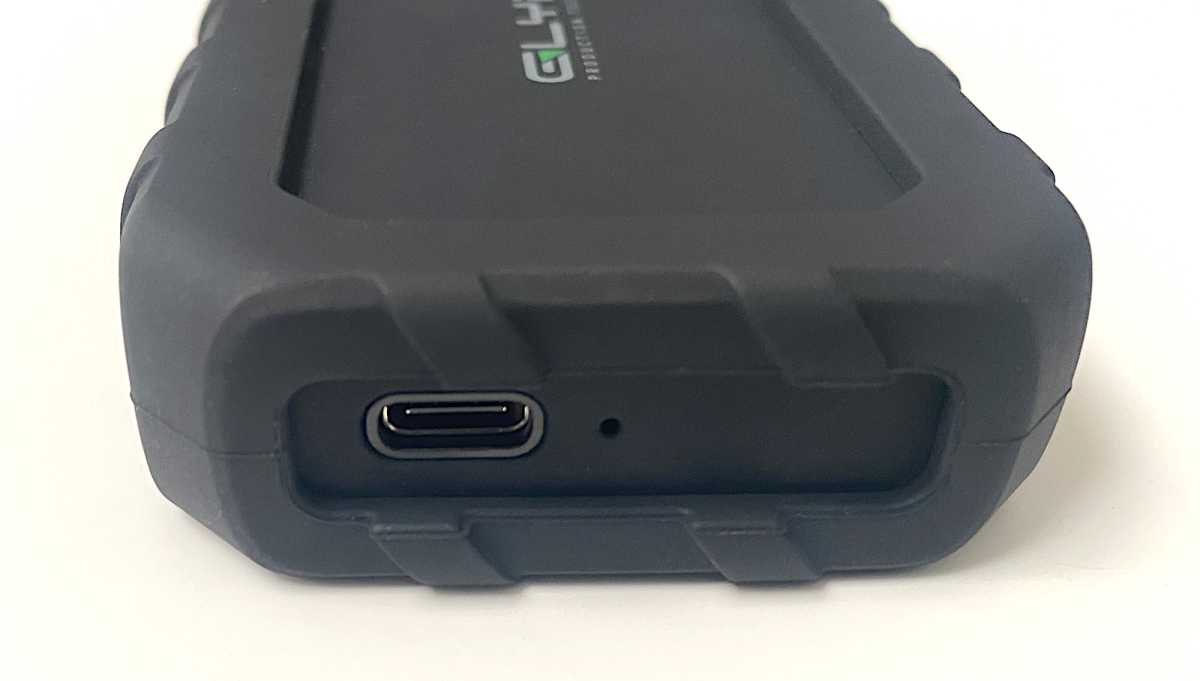
At 7.5 ounces (jacket included), the Atom EX20 is hardly the lightest external SSD I’ve tested, but the heft also gives you a sense of quality. It measures, jacket included, approximately 4.4-inches long, by 2.4-inches wide, by a little under an inch thick. Both the Type-C port and activity light are on the same end of the unit, with the port offset to the left.
The Atom EX20 is warrantied for three years with two of data recovery and one year of replacement. There’s no TeraBytes Written (TBW) rating, but figure around 600TBW, which is a whole lot of data. Remember, reads don’t count, only writes.
How much is the Glyph Atom EX20?
SSD prices had risen quite high at the time I first looked at the AtomEX20, but I was still a bit surprised at the Atom EX20’s rather steep pricing for a 20Gbps SSD: $310 for 1TB, $420 for 2TB, $700 for 4TB, and $1,500 for 8TB. However, three weeks more of prices soaring and it’s starting to look like a pretty good deal.
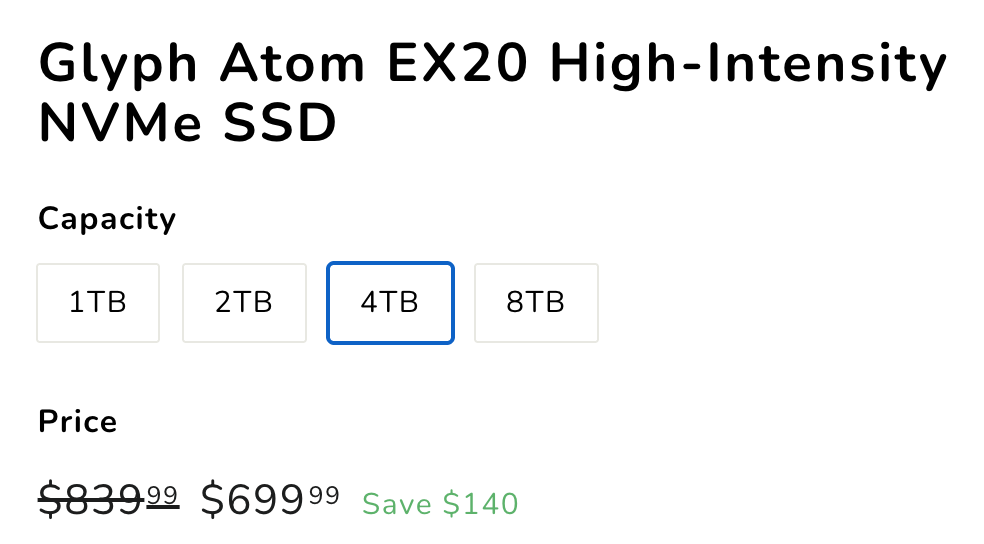
That said, the 40Gbps and only slightly pricier Glyph Atom EX40 (see the upcoming review) might be the better deal.
Note that the 40Gbps version of the OWC 1M2 enclosure is currently only $90 and might be married with an NVMe SSD for less. You might also wait six months to see if the whole AI/data center bubble bursts and SSD prices drop.
Glyph Atom EX20 performance caveats
Using the bundled 7-inch Type-C cable caused issues on our Windows test bed, with the EX20 initially writing at only 50- to 80MBps, and writing at only 20MBps on an M4 Mac. For whatever reason, read performance was over 2GBps, so the vexing conundrum might also be a firmware/handshaking issue.
That said, if you want the best, least problematic Type-C cables, use a Thunderbolt type — they’re completely compatible with USB and manufactured to tight tolerances. Indeed, using one solved the Atom EX20’s write performance issue.
This is not the first time I’ve used a bundled cable that didn’t allow full performance — the TerraMaster D1 SSD Pro had the same issue, albeit it was an 80Gbps cable that throttled to 20Gbps. That is said to be solvable via a firmware upgrade.
Note also, that as with all USB 3.2×2 SSDs, the Atom EX20 will fall back to 10Gbps without a dedicated 20Gbps port. This is because most systems without one don’t support the protocol, but do support the 10Gbps USB 3.2 Gen 2 standard.
How fast is the Glyph Atom EX20?
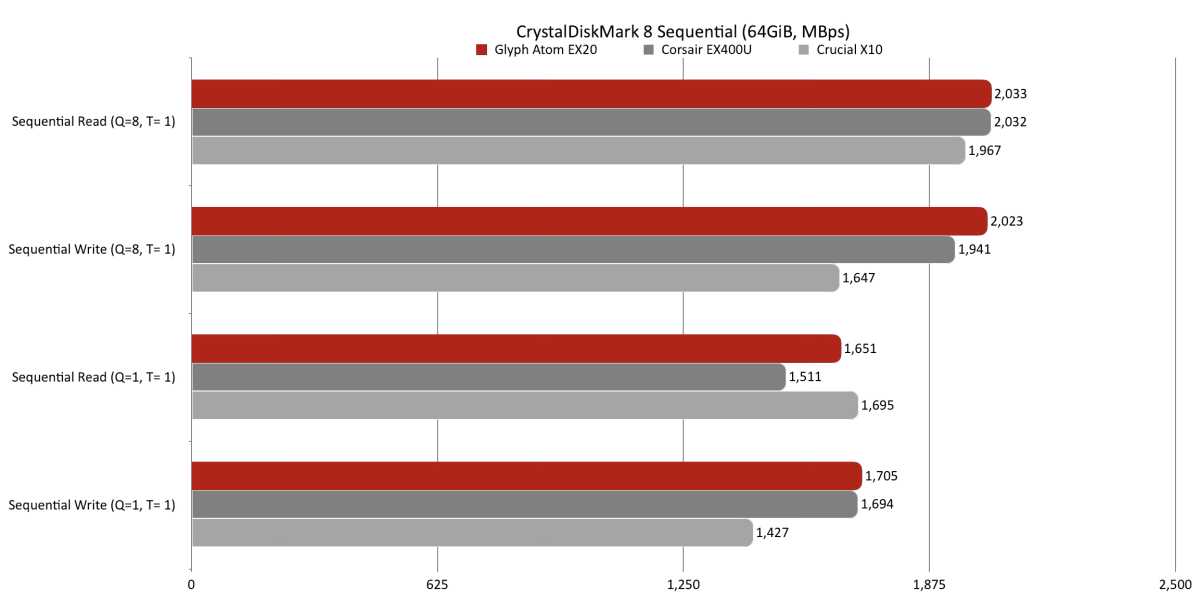
Once I switched cables, the 4TB Atom EX20 turned in a blistering performance. One that garnered it the number-two spot among all 20Gbps SSDs. The only drive to beat it was the Asus TUF Gaming A2, which is actually an unpopulated enclosure that I filled with an extremely fast Samsung 9100 Pro.
That was not particularly fair of me, so consider the EX20 the top dog in pre-populated 20Gbps USB. That’s borne out by the drive’s CrystalDiskMark 8 numbers shown below.
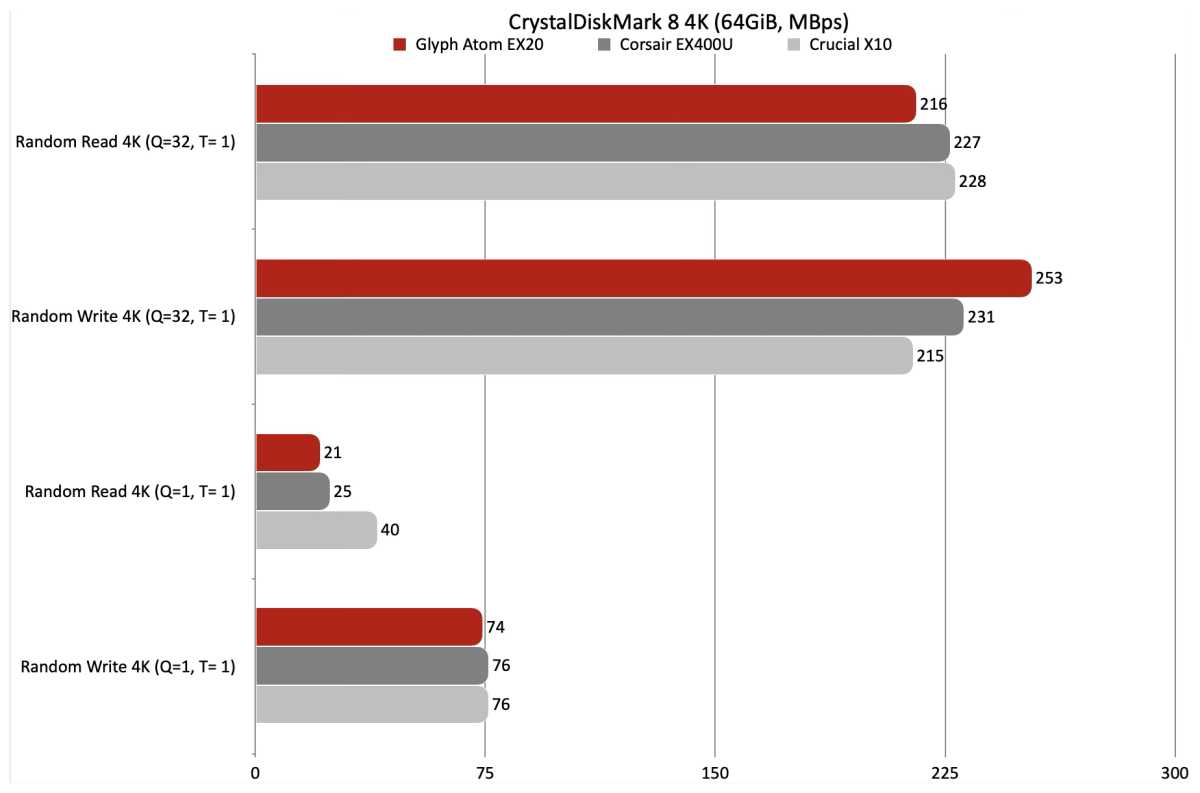
The Glyph Atom EX20 again competed nicely with its rivals (Corsair EX400U, Crucial X10) in the CrystalDiskMark 4K tests.
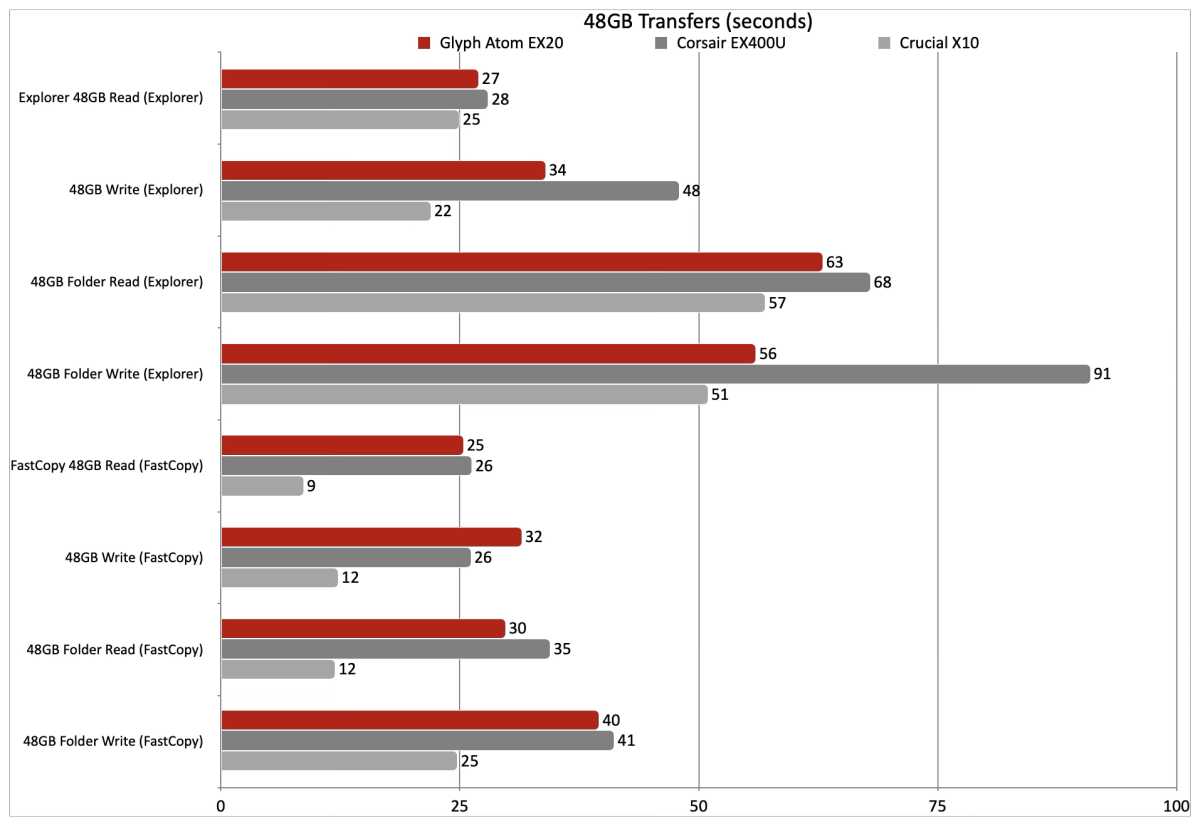
The Atom EX20 was competitive in our real-world 48GB transfers, though it didn’t show as much potential in the FastCopy tests as the Crucial X10.
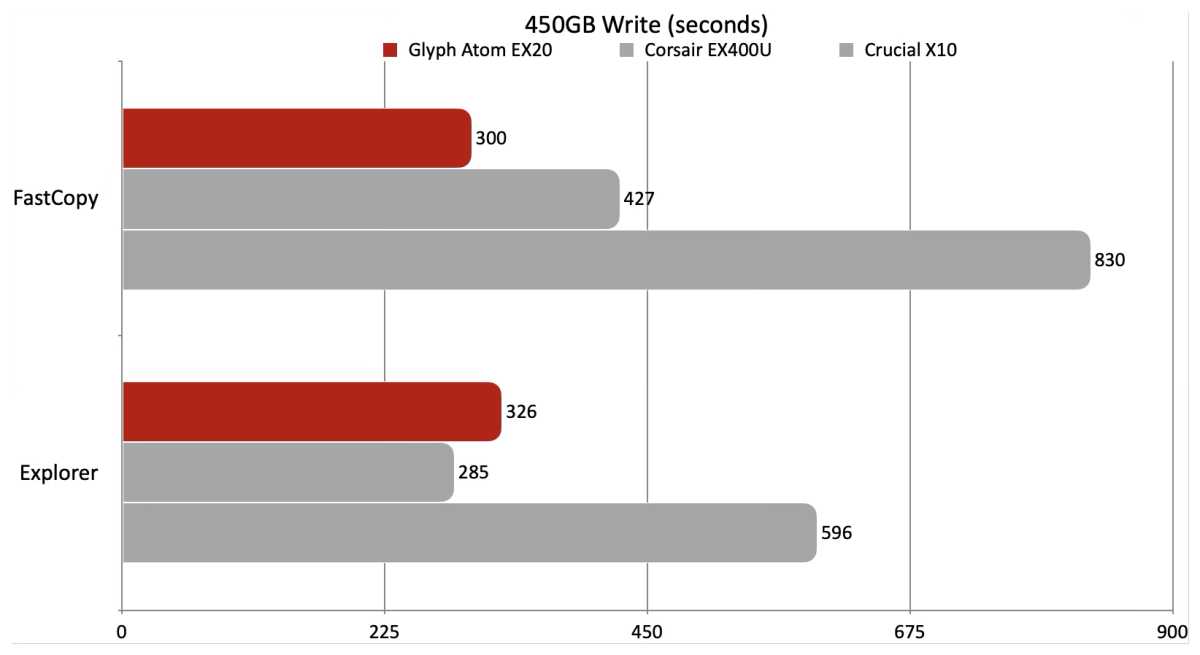
Being a 4TB SSD certainly helped the Atom EX20 in our 450GB write test (the others are 2TB). It had plenty of secondary cache to play with and never slowed significantly.
I have no complaints about the Atom EX20’s performance — it’s a very fast 20Gbps USB SSD.
Should you buy the Glyph Atom EX20?
In light of my experience with the cable and the price, the buy recommendation is… perhaps. But only because it’s difficult to judge if the current supply issues are a blip, or will only get worse. The EX20’s design and performance are excellent (cable/firmware excepted) so if you do decide to buy, the EX20 should be on your short list.
Glyph is looking into the cable issue, and will likely fix it by the time you read this. That said, test yours first thing using CrystalDiskMark 8 or another synthetic benchmark to make sure.
This article was edited on March 6, 2026 to significantly amend the pricing discussion which has changed due to the rapid rise in NAND prices. Also, the cable discussion was amended to discuss possible firmware issues.
How we test
Drive tests currently utilize Windows 11 24H2, 64-bit running off of a PCIe 4.0 Samsung 990 Pro in an Asus Z890-Creator WiFi (PCIe 4.0/5.0) motherboard. The CPU is a Core Ultra i5 225 feeding/fed by two Crucial 64GB DDR5 5600MHz modules (128GB of memory total).
Both 20Gbps USB and Thunderbolt 5 are integrated into the motherboard and Intel CPU/GPU graphics are used. Internal PCIe 5.0 SSDs involved in testing are mounted in an Asus Hyper M.2 x16 Gen5 adapter card sitting in a PCIe 5.0 slot.
We run the CrystalDiskMark 8.04 (and 9), AS SSD 2, and ATTO 4 synthetic benchmarks (to keep article length down, we report only the first) to find the storage device’s potential performance. Then we run a series of 48GB transfer and 450GB write tests using Windows Explorer drag and drop to show what users will see during routine copy operations, as well as the far faster FastCopy run as administrator to show what’s possible.
A 25GBps two-SSD RAID 0 array on the aforementioned Asus Hyper M.2 x16 Gen5 is used as the second drive in our transfer tests. Formerly the 48GB tests were done with a RAM disk serving that purpose.
Each test is performed on a NTFS-formatted and newly TRIM’d drive so the results are optimal. Note that in normal use, as a drive fills up, performance may decrease due to less NAND for secondary caching, as well as other factors. This issue has abated somewhat with the current crop of SSDs utilizing more mature controllers and far faster, late-generation NAND.
Best Prices Today: Glyph Atom EX20 20Gbps SSD
Author: Jon L. Jacobi, Contributor, PCWorld

Jon Jacobi is a musician, former x86/6800 programmer, and long-time computer enthusiast. He writes reviews on TVs, SSDs, dash cams, remote access software, Bluetooth speakers, and sundry other consumer-tech hardware and software.